
InArts Lab Member Dalila Honorato Participates in LASER São Paulo – “Chimeric Bodies and Machine Hauntologies” in Brazil
05-12-2025 21:57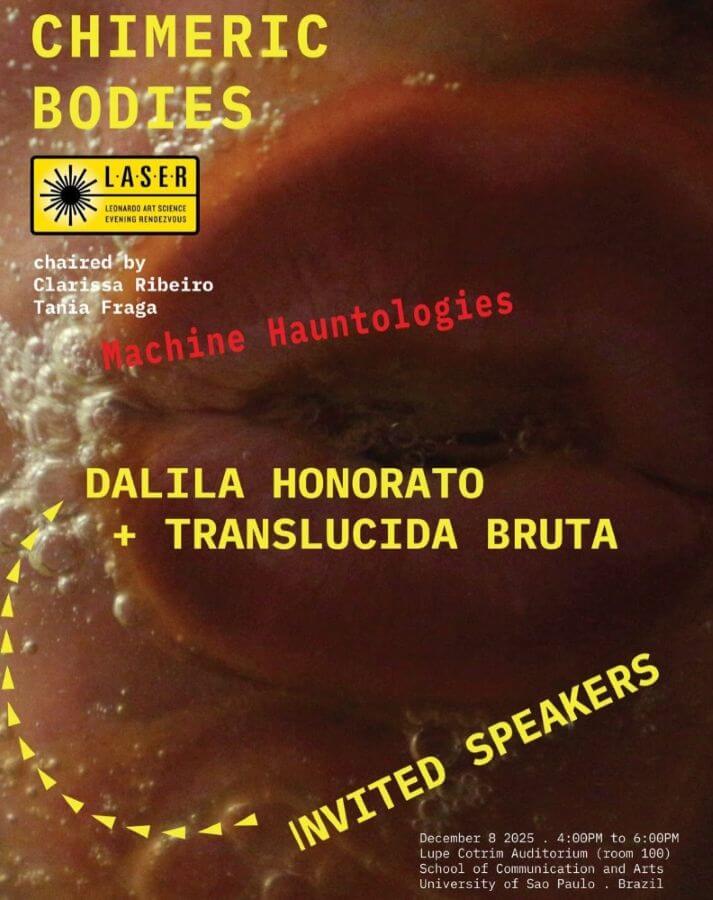
The Interactive Arts Research Lab (InArts) of the Department of Audio and Visual Arts at the Ionian University announces the participation of Professor Dr. Dalila Honorato, member of InArts Lab, in LASER São Paulo – “Chimeric Bodies and Machine Hauntologies,” taking place on Monday, December 8, 2025, at the School of Communications and Arts of the University of São Paulo, Brazil.
The event will be held at the Lupe Cotrim Auditorium, in the main building of the School of Communications and Arts, during the afternoon and evening, under the chairship of Clarissa Ribeiro and Tania Fraga.
This edition of LASER Talks São Paulo brings together two artists and researchers, Dalila Honorato (Ionian University, Greece) and Carolina Sudati, also known as Translúcida Bruta (Brazil), whose practices explore the porous boundaries between embodiment, technology, affect, and the spectral dynamics of contemporary media ecologies.
The event will investigate the sensorial, semiotic, and ontological dimensions of emerging forms of hybrid existence, examining how machinic hauntologies, algorithmic phantasmagoria, and the aesthetics of the cybernetic gothic intersect with visceral bodies, ritual gestures, and the politics of becoming-other.
Dalila Honorato: Chimeric Bodies, Monstrosity, and the Boundaries of Hybrid Existence
Dalila Honorato will contribute to the discussion through her longstanding research on embodiment, monstrosity, the uncanny, and the liminal tensions between phobia and paraphilia. Her work, developed through international initiatives such as Taboo–Transgression–Transcendence in Art & Science (TTT) and FEMeeting, examines how contemporary chimeric and hybrid forms, both biological and computational, reconfigure the thresholds of identity, intimacy, and epistemic risk in a world increasingly shaped by machinic intelligence.
Carolina Sudati (Translúcida Bruta): Bodily Transformations, Technologies, and Ritual Practices
Carolina Sudati, known artistically as Translúcida Bruta, will expand this discussion through her corporeal and performative investigations combining wearable technologies, ritualistic movement, and the transmutation of psycho-emotional constraints into kinetic expansion. Her artistic practice engages with vegetal hacking, mineral ecologies, neo-extractivist residues, and trance-based practices, revealing the material and spectral dimensions of the post-industrial body.
By bringing together these two artistic and research perspectives, LASER São Paulo – Chimeric Bodies and Machine Hauntologies fosters an interdisciplinary dialogue on bodily transformations, the interconnections between organic and technological systems, and the sociopolitical and aesthetic implications of contemporary hybrid existence.
Dalila Honorato is a Professor at the Department of Audio and Visual Arts of the Ionian University and a member of the Interactive Arts Research Lab (InArts). Her research and artistic activities focus on the intersections of art, science, technology, and critical approaches to embodiment and hybrid identities. Through her involvement in international interdisciplinary initiatives, she contributes to the development of collaborative networks connecting artistic experimentation, scientific inquiry, and critical reflection.
Her participation in LASER São Paulo reflects the international research activity of InArts Lab and its engagement with contemporary discussions on art, science, emerging technologies, and the evolving relationships between human and non-human forms of existence.
Event Information
-
Date: Monday, December 8, 2025
-
Time: Afternoon and evening
-
Venue: Lupe Cotrim Auditorium, School of Communications and Arts, University of São Paulo
-
Address: Professor Lúcio Martin Rodrigues Avenue, 443, University Town, São Paulo, Brazil
-
Theme: Chimeric Bodies and Machine Hauntologies
-
Chairs: Clarissa Ribeiro and Tania Fraga
For more information about the research activities and related initiatives, visit:
Back